
Introduction
Gravity is one of the most familiar phenomena in nature. We observe objects falling, planets orbiting stars, and galaxies interacting across vast distances. The existence of gravity is beyond doubt because its effects can be measured, calculated, and predicted.
Yet an important question remains:
What ultimately produces gravity?
Newton described gravity mathematically but did not explain its origin. Einstein reformulated gravity as spacetime curvature, but quantum mechanics and cosmology demonstrate that our understanding of gravity remains an active area of research. Modern physics continues to search for a deeper understanding, proposing hypotheses ranging from string theory to quantum gravity loop models.
In this context, standard methodology allows scientists to measure and model observations even when underlying mechanisms are unknown.
This principle provides a useful perspective when considering psychokinesis.
Observation Before Explanation
The observation of a phenomenon and the explanation of that phenomenon are not the same thing.
For gravity:
- We observe falling objects.
- We measure gravitational acceleration.
- We model the effect mathematically.
- The ultimate cause remains under investigation.
For psychokinesis:
- Physical effects (e.g., force applied, displacement) can be measured using standard mechanical principles or sensitive instrumentation.
- The motion may be measured.
- The outcome can be modeled.
- The underlying mechanism remains hypothetical.
Thus methodology in psychokinesis can be structured at two levels:
Level 1: Observable Effects
What can be measured?
OBSERVATION – PHYSICS & PHYSICS MODELS
Level 2: Underlying Cause
What produces the measurement?
THE THEORY OF PSYCHOID SPACETIME COMPENSATION PSC
The Psychoid Hypothesis
One direction of research proposes that psychokinesis, like gravity, originates in a broader field structure.
For the purpose of this concept, let:
represent a psychoid field or psychoid influence.
The term psychoid originates in depth psychology and philosophy. In this context it is intended to describe observed interactions between consciousness and matter.
A Proposed Psychokinetic Model
By analogy:
Gravitation:
Psychokinesis:
or mathematically:
Where:
- Ψ = psychoid field
- FPK = psychokinetic force [N]
- x(t) = motion / displacement [m]
Mechanical Manifestation
For a psychokinetic force applied to a mass:
and for static gravity:
If tilting of a table is observed, mechanical forces and overturning moments can be evaluated through standard structural analysis. The tipping condition becomes:
where the overturning moment generated by a horizontal force Fh at height h is:
and the restoring gravitational moment is:
The motion itself may be measured regardless of one’s interpretation of its cause.
Information Versus Force
A central point of psychokinesis is:
The movement is rarely chaotic. The movement often conveys information.
This suggests that information, rather than raw mechanical force alone, is a primary quantity of interest.
Let:
represent information transfer.
Then:
where force and information become manifestations of the same underlying process.
Spirit Identification
If intelligent communication occurs through physical movement, a simple identification index can be defined:
where:
- Na = number of correct answers
- Nq = total number of questions
A high score index (0 ≤ SI ≤ 1) indicates strong agreement between requested and observed answers.
The emphasis shifts from force alone to a combination of physical movement guided by meaningful information.
Psychoid Efficiency
A useful engineering measure is the relationship between information transferred and mechanical energy expended.
Let:
be the required observable mechanical energy [J].
Then define psychoid efficiency (ηP):
where:
ηP represents psychoid efficiency.
A high value indicates a system producing large amounts of meaningful information while requiring relatively little observable mechanical energy.
Comparison with Gravity
The comparison between gravity and psychokinesis is not that they are identical forces.
The comparison is methodological.
| Gravity | Psychokinesis |
|---|---|
| Observable effect | Claimed observable effect |
| Mathematical description possible | Mathematical description possible |
| Underlying cause debated historically | Underlying cause hypothetical |
| Field concept used | Field concept proposed |
| Motion measurable | Motion measurable |
The essential point is that scientific investigation often begins with the observation of effects before the underlying mechanism is fully understood.
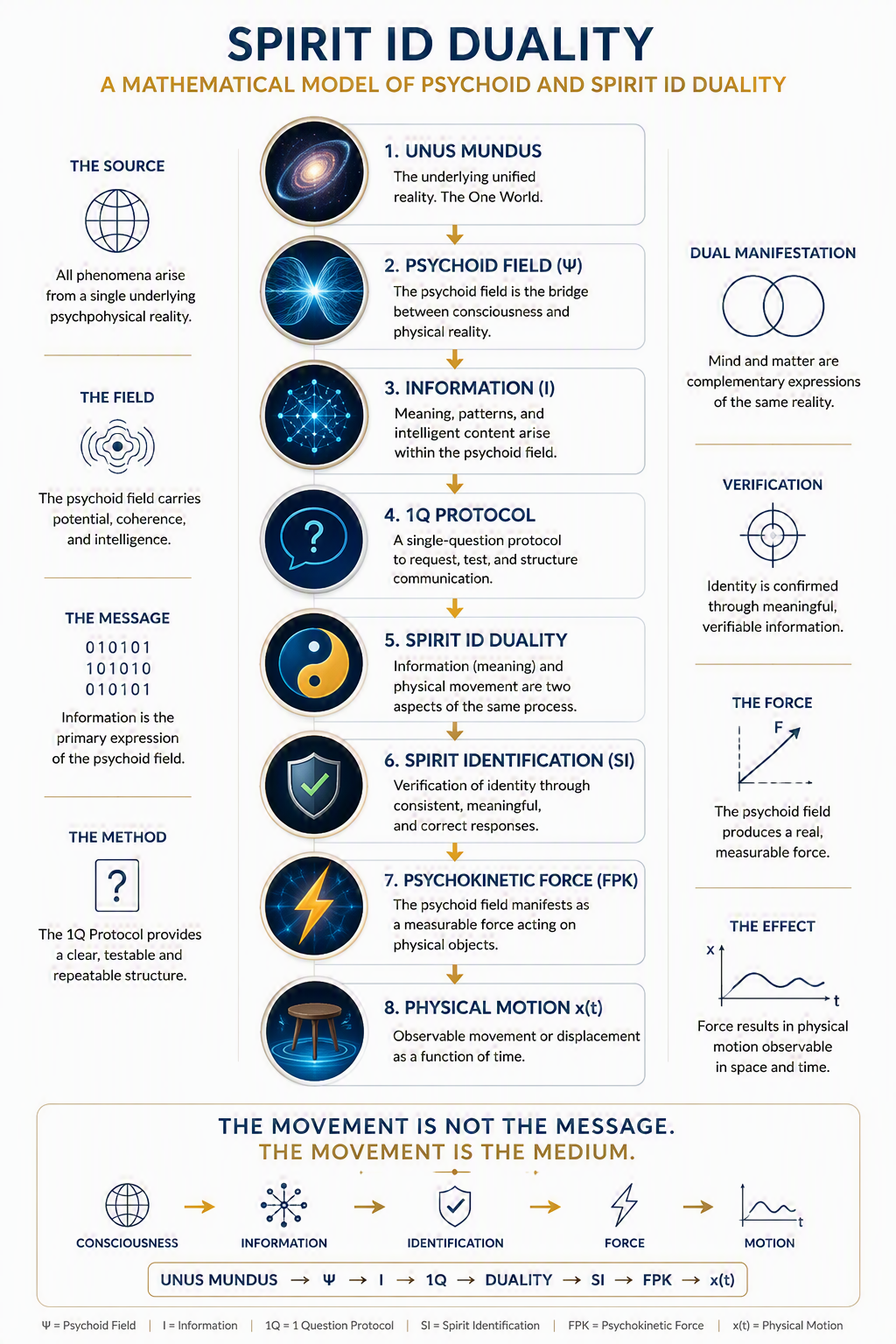
A Unified Conceptual Framework
The model proposed here may be summarized as:
where:
- Ψ = Psychoid Field
- I = Information
- FPK = Psychokinetic Force [N]
- x(t) = Physical Motion / Displacement [m]
In this framework, psychokinesis is not the primary phenomenon. It is merely the measurable expression of a deeper psychoid interaction in which information and consciousness play a central role.
Conclusion
Gravity was measured long before its nature was understood. Modern physics still seeks a deeper explanation of its ultimate origin. Likewise, a psychoid model does not claim to explain consciousness-matter interaction definitively. It simply provides a conceptual and mathematical framework within which observations can be discussed, measured, and compared.
If gravity may be viewed as the influence of matter on matter, then the psychoid hypothesis proposes:
as a possible relationship worthy of investigation.
The purpose of this model is therefore not to claim a final answer, but to provide a structured engineering framework for exploring the possibility that information and consciousness may under certain conditions produce measurable physical effects.