Spirit ID®
for Society
Spirit ID extends the question of consciousness survival into the social domain. It frames identity, responsibility, and continuity as foundations for how societies are shaped, how power is exercised, and how consequences are understood beyond short-term outcomes. In this perspective, ethics is not imposed from outside — it arises naturally from recognizing who we are, and what endures.
↳ Further reading:
Spirit ID for Society
SPIRIT ID® COLD CASE METHODOLOGY
Working Paper 2026
Cold Case Research examines unresolved cases through observation, pattern recognition, identity analysis, anomaly assessment, and structured verification.
Within the Spirit ID® Framework, unresolved cases are regarded as incomplete puzzles in which significant information may remain undiscovered, overlooked, or insufficiently connected.
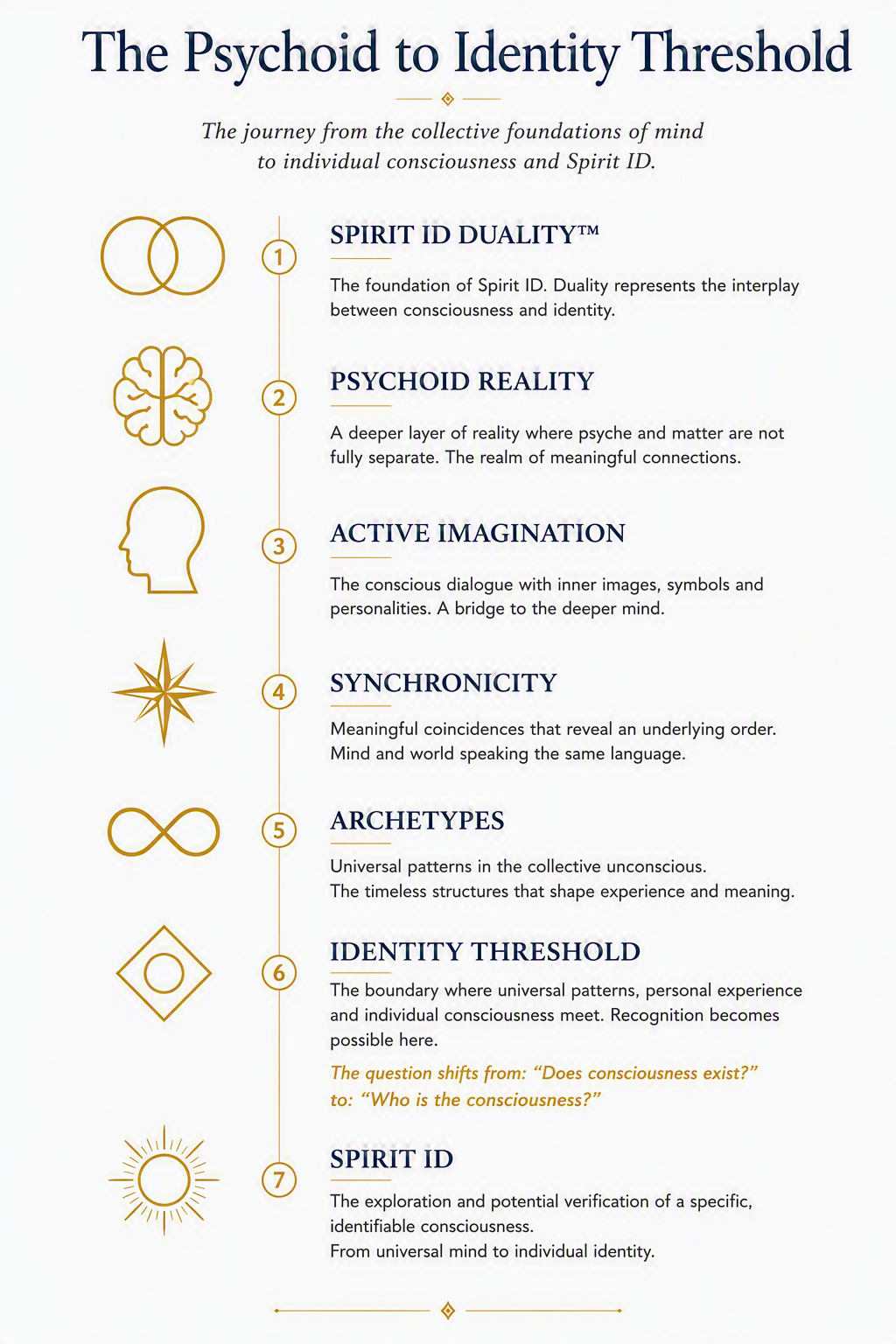
The objective is not to replace conventional investigative methods, but to identify, document, analyze, and evaluate potentially significant patterns through a transparent and systematic methodology based on the Spirit ID Duality, a psychoid reality where psyche and physicality may be meaningfully interconnected.
Every unresolved case raises the same question:
What piece of the puzzle is still missing?
What is the missing move?

Kommende utgivelser
Norwegian
Spirit ID utforsker spørsmål om identitet, bevissthet og menneskets dypeste natur. Gjennom romaner, historiske mysterier og spenningsfortellinger søker Jostein Strømmen å gjøre disse temaene tilgjengelige for alle. Kommende bokserier forener historie, kunst, filosofi og mysterier i fortellinger som utfordrer etablerte forestillinger og inviterer til nye perspektiver.
A structured observational approach.
A recorded event, a simple response system, and a consistent body of text are brought together as observable material.

→ View the recorded session (March 7, 2013)


Science meets the unknown
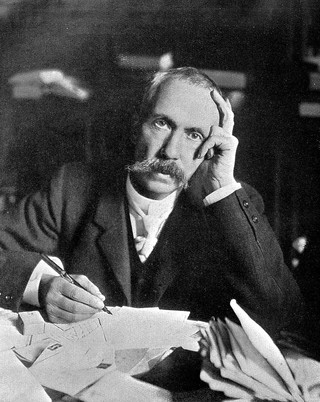
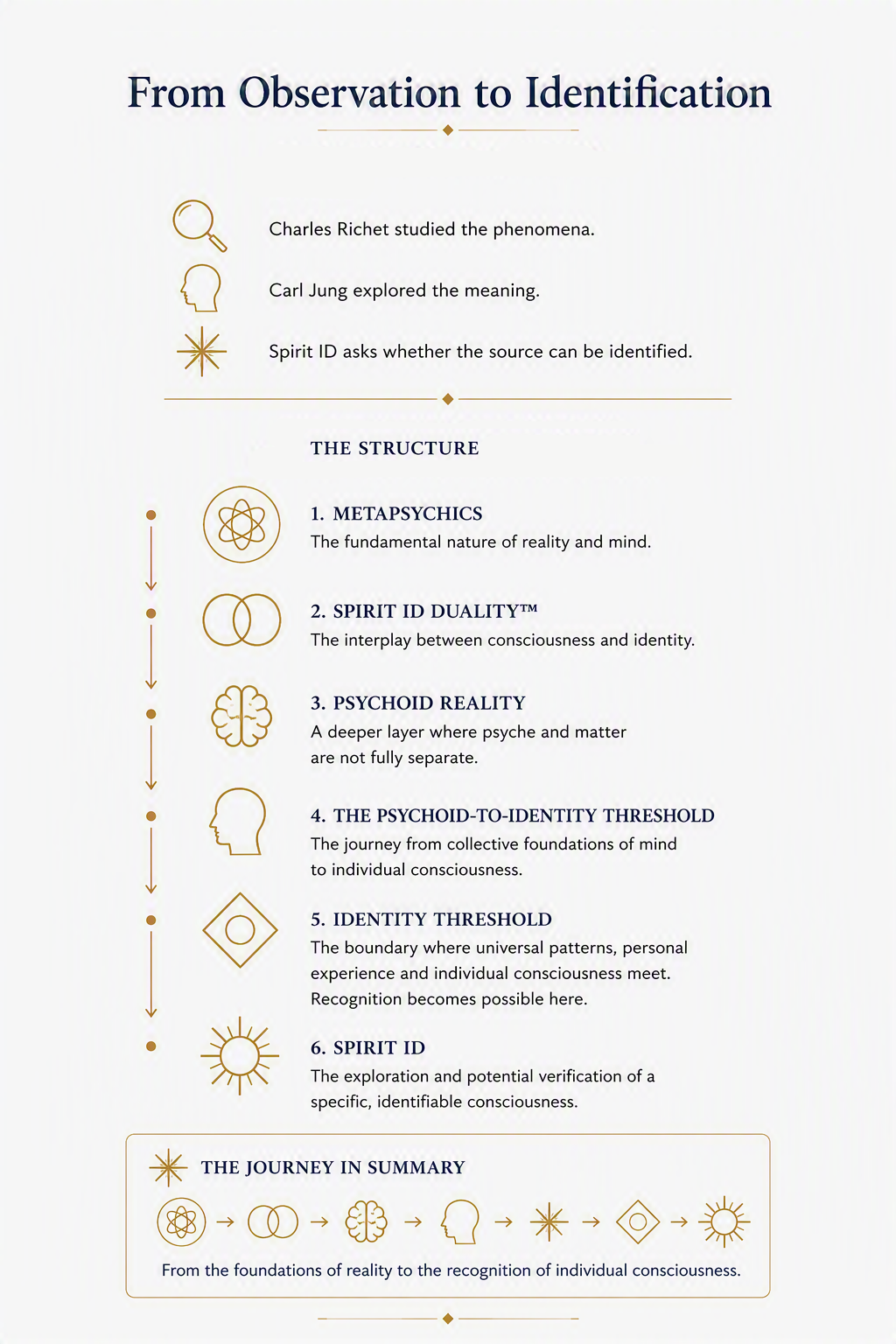
Charles Richet occupies a singular position in the history of science. As a Nobel Prize–winning physiologist, his scientific credibility was beyond dispute. At the same time, his decision to investigate phenomena that challenged materialist assumptions placed him at the edge of accepted inquiry.
Richet did not approach anomalous phenomena as a mystic or a believer. He approached them as a scientist confronted with observations that resisted reduction to known sensory, psychological, or physiological mechanisms.
In doing so, he reached a frontier that modern science has largely chosen not to cross.
C.G. Jung — Psychoid and the Spirit ID Duality™

Spirit ID® builds on Jung’s descriptive approach to border phenomena and his insight into the psychoid — the threshold where inner and outer experience meet. Jung’s view of the unconscious as a dynamic field, rather than a container of fixed contents, provides a historical reference point for understanding mind–matter boundary events.
Spirit ID Duality™ advances this perspective by separating internal impressions from external non‑evidentiary impulses, and by requiring independent verification before any claim is considered evidential. In this way, Spirit ID® continues Jung’s methodological restraint while offering a modern structural framework for evaluation. This establishes the basis for a methodological step: the transition from psychological description to identity-based verification.