The Theory of Psychoid Spacetime Compensation (PSC)
Abstract
The Theory of Psychoid Spacetime Compensation (PSC) proposes a unified psychophysical model in which mind and matter emerge from a common ontological substrate known as Unus Mundus. Drawing inspiration from Carl Jung’s concepts of the collective unconscious, synchronicity, and the psychoid level of reality, PSC hypothesizes the existence of a psychoid field capable of interacting directly with spacetime geometry.
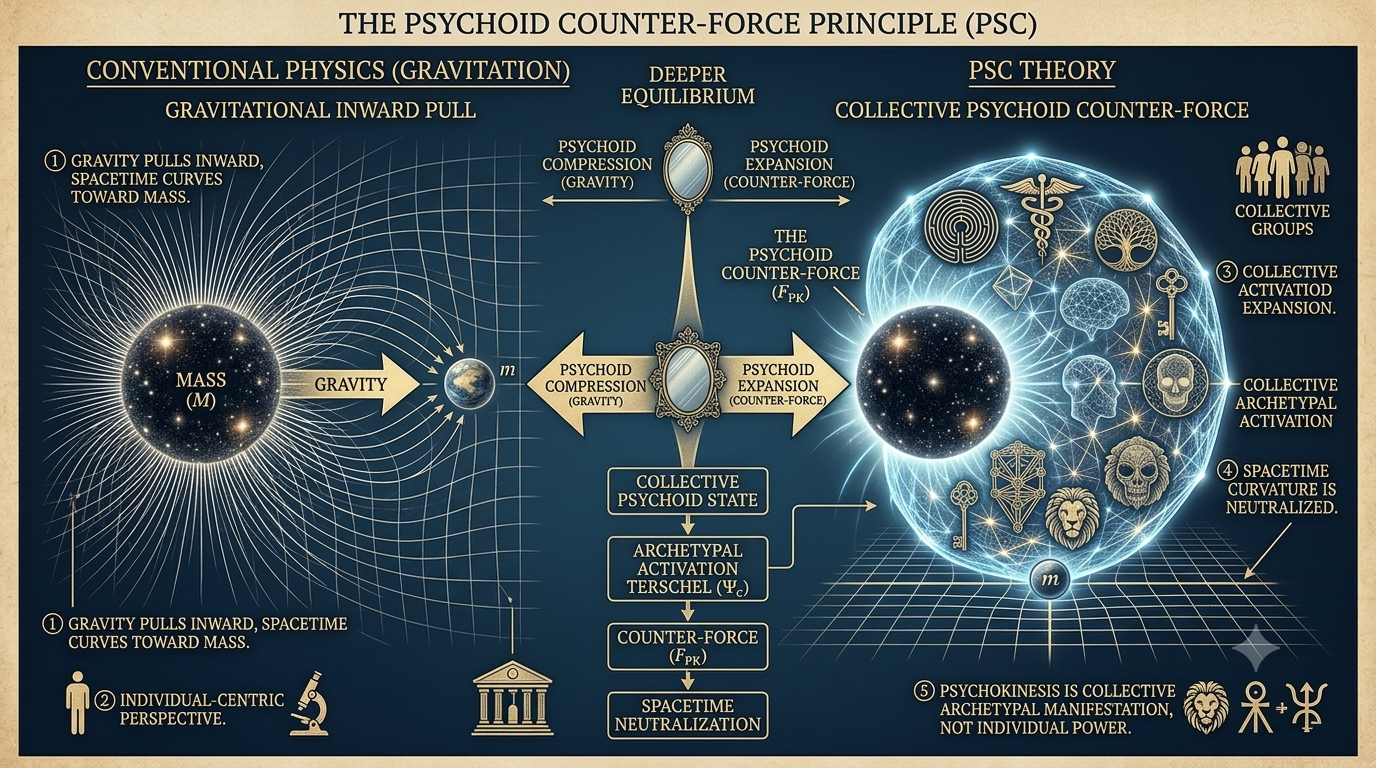
Within this framework, gravitation and collective consciousness are interpreted as complementary expressions of a deeper underlying reality. Gravitation functions as the inward-curving tendency of matter to organize spacetime, while the psychoid field functions as an outward-compensating tendency associated with collective archetypal activation.
The theory introduces a hypothetical mathematical term, the Psychoid Tensor, into Einstein’s field equations and proposes a psychoid wave function representing the state of collective consciousness. Under conditions of extreme synchronicity and archetypal resonance, the psychoid field is hypothesized to counteract gravitational curvature, producing localized phenomena of apparent weightlessness.
The model is intended primarily as a metaphysical and conceptual framework rather than an established physical theory.
1. Introduction
Modern civilization inherited two fundamentally different descriptions of reality.
The first originates in physics and describes matter, energy, space, and time through objective measurement. The second originates in psychology and describes meaning, consciousness, symbols, and subjective experience.
Despite tremendous advances in both domains, no generally accepted framework has emerged that fully explains the relationship between psyche and matter. Carl Jung proposed that both domains might originate from a deeper reality which he termed Unus Mundus, or “The One World.”
Within this conception:
- Matter and mind are not separate substances.
- They are complementary manifestations of a deeper order.
- Synchronicities arise when both domains reveal a common underlying structure.
The present theory attempts to formalize this intuition.
2. Ontological Foundation
2.1 Unus Mundus
PSC begins with a single foundational assumption:
Reality consists of a unified psychophysical continuum known as Unus Mundus.
This continuum possesses two primary modes of expression:
Physical Expression
- Matter
- Energy
- Spacetime
- Gravitation
Psychological Expression
- Consciousness
- Archetypes
- Collective unconscious processes
- Symbolic meaning
Neither aspect is viewed as fundamental; both emerge from a deeper source.
2.2 The Psychoid Layer
Jung introduced the concept of the psychoid to describe processes that appear neither strictly mental nor strictly physical. PSC identifies the psychoid domain as the interface through which:
- Psyche influences matter,
- Matter reflects psychic organization,
- Synchronicities become possible.
The psychoid level therefore functions as a bridge between subjective and objective reality.
3. The Psychoid Counter-Force Principle
The central postulate of PSC is:
Psychokinesis is not an individual power but a manifestation of a collective psychoid counter-force acting against gravitation.
In conventional physics, gravity pulls inward and spacetime curves toward mass. In PSC, collective archetypal activation produces an opposing tendency: psychoid compression becomes psychoid expansion, and spacetime curvature is partially neutralized. These forces form complementary expressions of a deeper equilibrium.
4. Mathematical Formalism
4.1 Modified Einstein Equation
The PSC framework introduces a correction term into Einstein’s field equations:
Where:
- Standard Terms:
- \(G_{\mu\nu}\): Einstein curvature tensor
- \(T_{\mu\nu}\): Stress-energy tensor
- \(\Lambda\): Cosmological constant
- \(g_{\mu\nu}\): Metric tensor
- New Psychoid Term:
- \(P_{\mu\nu}(\Psi)\): Psychoid Tensor. This hypothetical field represents the tendency of collective consciousness to flatten spacetime curvature.
4.2 Psychoid Wave Function
The state of the global psychoid field is represented by:
Where:
- \(N\): Total number of conscious participants
- \(\psi_n\): Degree of unconscious synchronization
- \(\chi_n\): Ego Suppression Factor
- \(\Omega_{\text{ark}}\): Archetypal Resonance Constant
5. The Consciousness Variables
5.1 Unconscious Synchronization (\(\psi_n\))
This quantity measures the degree to which an individual’s unconscious state aligns with a collective archetypal pattern. Values increase when individuals experience similar symbolic content, emotional states become synchronized, and collective meaning emerges.
5.2 Ego Suppression Factor (\(\chi_n\))
This factor represents the degree to which individual will is absent:
- \(\chi_n = 0\) represents complete ego dominance.
- \(\chi_n = 1\) represents complete surrender to the collective field.
5.3 Archetypal Resonance Constant (\(\Omega_{\text{ark}}\))
This parameter measures the magnitude of an activated archetype (e.g., The Self, Birth, Death, Apocalypse, Transformation, Redemption). The more universal the archetype, the greater the value of \(\Omega_{\text{ark}}\).
6. Critical Psychoid Threshold
PSC proposes the existence of a critical value \(\Psi_c\). At this threshold:
The inward curvature created by mass is exactly balanced by the outward psychoid field. Consequently:
for a localized region. In theoretical terms, gravitational influence vanishes.
7. The Three Laws of Psychoid Dynamics
- Law I: Ego-Vacuum
Psychoid effects cannot be intentionally produced by individual consciousness. The act of deliberate control suppresses the phenomenon, decreasing \(\chi_n\) toward zero. - Law II: Archetypal Mass
The strength of psychoid compensation is proportional to the archetypal depth of collective experience. Shallow emotions produce negligible effects; primordial archetypes generate maximum effects. - Law III: Synchronistic Equilibrium
Physical manifestations always correspond to meaningful psychological states. No psychoid event is random; every external occurrence reflects an internal collective condition.
8. A Conceptual Model
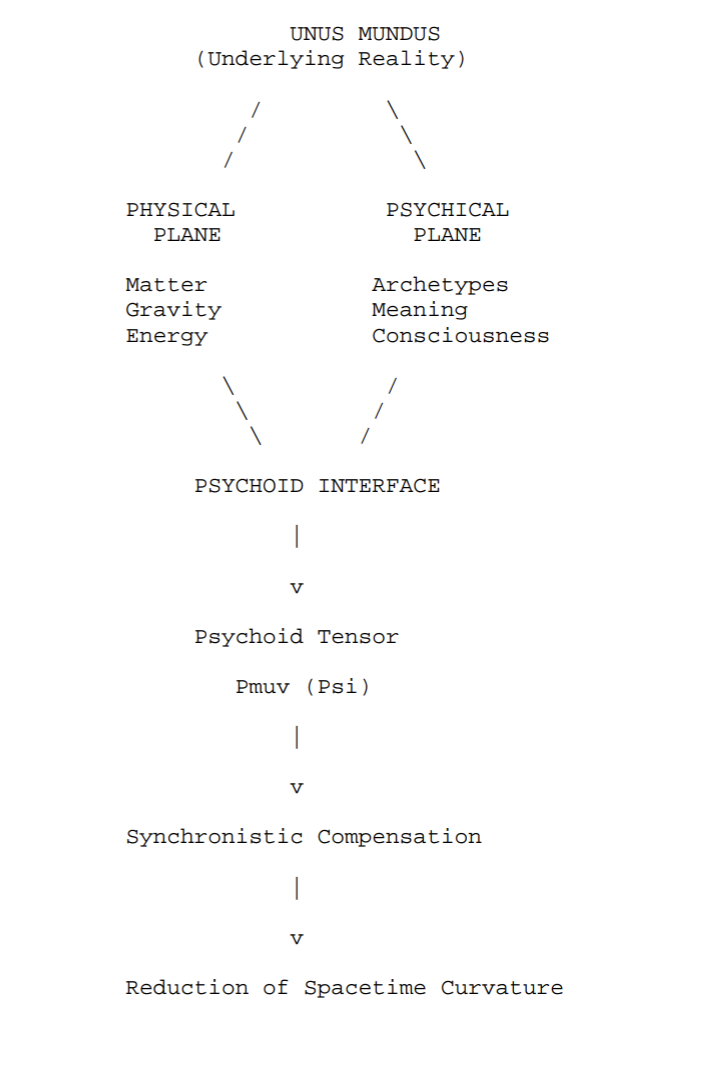
The PSC model proposes that both physical and psychological phenomena arise from a common substrate known as Unus Mundus.
The physical domain manifests through matter, energy, gravitation, and spacetime geometry. The psychological domain manifests through consciousness, archetypes, symbolic meaning, and collective unconscious processes.
These two domains converge at the psychoid interface, where collective archetypal resonance generates the psychoid field represented mathematically by the Psychoid Tensor \(P_{\mu\nu}(\Psi)\). When the psychoid field reaches sufficient intensity, it acts as a compensatory mechanism against spacetime curvature, producing what PSC describes as synchronistic compensation.
9. Example Scenario
Consider a global existential crisis where humanity collectively confronts extinction. Fear eventually gives way to complete acceptance, leading millions to enter the same archetypal condition simultaneously.
The variables evolve toward:
- \(\psi_n \to 1\)
- \(\chi_n \to 1\)
- \(\Omega_{\text{ark}}\) reaches maximum value through activation of a collective archetype of transcendence.
The resulting increase in \(\Psi\) activates the psychoid tensor. Spacetime curvature decreases, and localized regions experience apparent weightlessness. Buildings, objects, and individuals rise from the ground. No individual causes the event; rather, the event emerges as an objective manifestation of collective psychological transformation.
10. Philosophical Implications
- Consciousness is Cosmological: Consciousness is not merely an emergent property of matter; it participates directly in reality’s structure.
- Synchronicity is Objective: Meaningful coincidences arise from lawful processes operating beneath conventional causality.
- Matter and Psyche are Complementary: Mind and matter emerge from a shared foundation. Neither can be fully understood independently.
- Evolution Includes Consciousness: Human development may involve not only biological but psychophysical transformation.
11. Limitations
The theory therefore occupies the domain of metaphysics, depth psychology, symbolic cosmology, and speculative psychophysical philosophy. It should not be considered established science.
Conclusion
The Theory of Psychoid Spacetime Compensation proposes that gravitation and collective consciousness are complementary manifestations of a deeper psychophysical reality known as Unus Mundus.
Through the hypothetical action of a psychoid field, collective archetypal synchronization may produce a compensatory effect upon spacetime curvature. Within this framework, psychokinesis is reinterpreted as a cosmological process rather than an individual ability.
Whether understood as symbolic metaphysics, speculative cosmology, or a future psychophysical paradigm, PSC seeks to provide a coherent language through which psyche and matter can once again be viewed as aspects of a single underlying reality.