
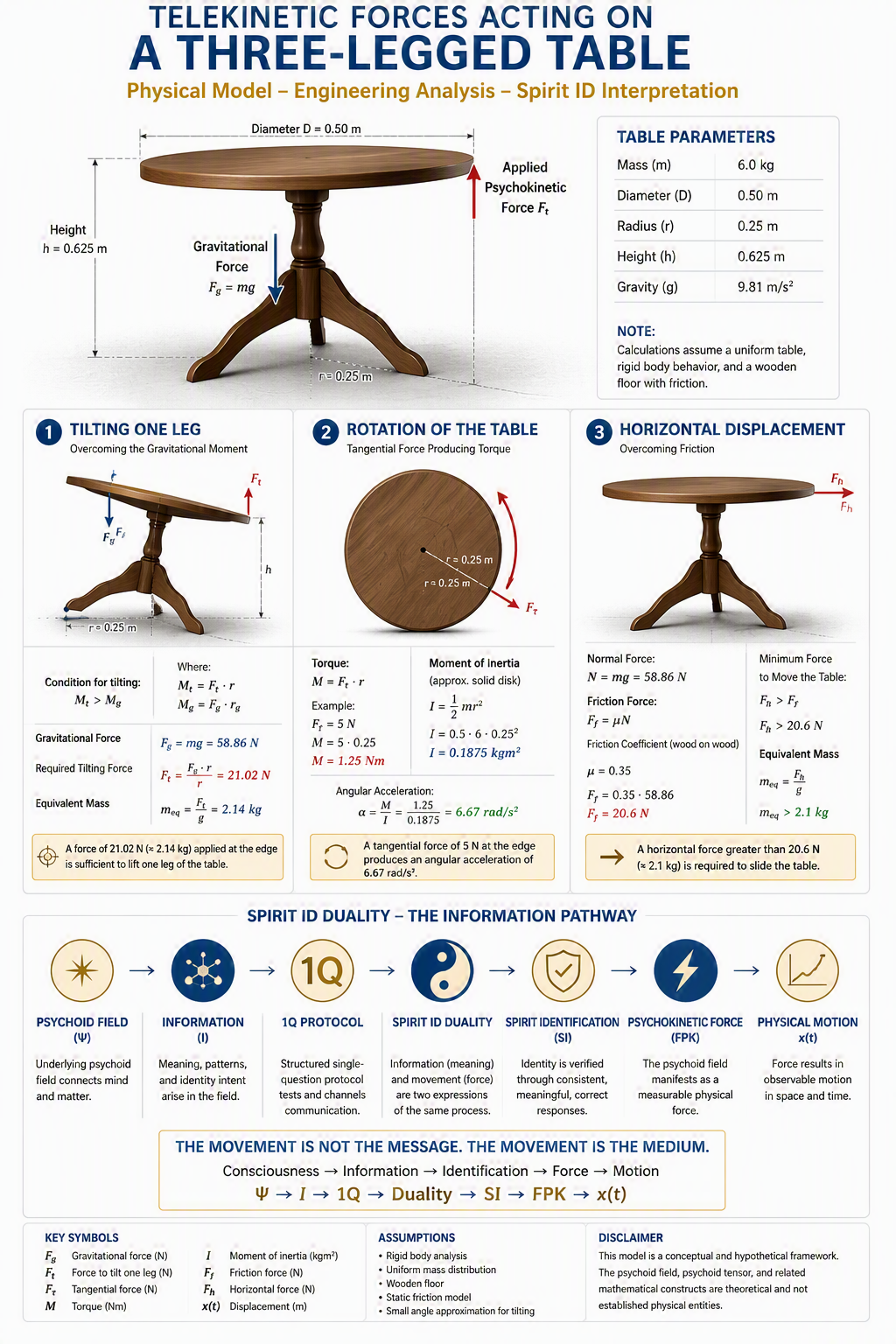
Application of a Round Three-Legged Table
1. The measurable mechanical effect (observed movement, tipping, or rotation of the table).
2. The hypothetical/psychological effect (evaluating potential non-contact or anomalous force application).
Description of the test parameters:
The baseline model assumes a circular table with the following parameters:
- Table Mass: m = 6.0 kg
- Table Diameter: d = 0.50 m
- Distance between legs (Table B): dB = 0.50 m
1. Force Required to Tilt the Table
Gravitational force acting on the mass:
Fg = 6.0 kg · 9.81 m/s² = 58.86 N
To tilt the table, the overturning moment about the pivot point (the outer leg) must exceed the restoring gravitational moment.
Distance from center of gravity to the tipping pivot point:
r = 0.25 m
Height of force application point on the tabletop:
h = 0.70 m
Overturning condition (Static Equilibrium Boundary):
Fh = (58.86 N · 0.25 m) / 0.70 m
Fh = 21.02 N
Mass equivalent load:
This represents the minimum threshold force (21.02 N applied horizontally at h = 0.70 m) required to initiate tipping in this model.
2. Rotation of the Table
Applied Torque (Moment):
If a tangential force of Ftan = 5.0 N is applied at the outer edge (r = 0.25 m):
Moment of Inertia (assuming uniform thin disk approximation):
I = ½ · 6.0 kg · (0.25 m)² = 0.1875 kg·m²
Angular Acceleration:
α = 1.25 N·m / 0.1875 kg·m² = 6.67 rad/s²
3. Horizontal Displacement
Assuming a coefficient of static friction between the table legs and the floor of:
μs = 0.35
Friction Resistance Force:
Ff = 0.35 · 6.0 kg · 9.81 m/s² = 20.60 N
Minimum horizontal force required to cause sliding:
Equivalent thrust mass load:
4. General Telekinetic Model
If the observed physical manifestation (force or torque) is modeled phenomenologically as:
Where:
- K = Physical transfer constant / Coupling efficiency
- C = Focus / Intent / Mental Coherence factor
- S = Sender potential / Object susceptibility parameter
This equation provides a conceptual abstraction that must be calibrated experimentally against measured physical displacements.
5. Spirit Identification Index (SI) & Combined Model
To evaluate whether the observed physical movement carries intelligent communication rather than random noise, we introduce a quantitative accuracy metric:
Where:
- Na = Number of correct/intended response signals
- Nq = Total number of query signals
Score Index Range:
A highly coherent test outcome yields, for example:
Combined Physical-Informational Indicator:
To quantify the combined magnitude of the physical movement and its informational coherence, we define the Effective Targeted Force Index (Feff):
While the mechanical equations (Sections 1–3) define the observed physical forces (Fobs in Newtons), the Spirit Identification Index (SI) scales this force according to its informational accuracy. This integrates both physical mechanics and informational intentionality into a unified empirical metric.