An exploration of the foundations of consciousness, meaning and identity.
The Psychoid to Identity Threshold presents a conceptual journey through some of the most influential ideas developed by Carl Gustav Jung, culminating in the question that lies at the heart of Spirit ID:
Can a specific consciousness be recognized and identified?
The framework begins with Jung’s concept of the psychoid, a level of reality where psyche and matter may arise from a common source. It continues through Active Imagination, Synchronicity and Archetypes, each contributing to our understanding of meaning, symbolism and human experience.
The journey reaches its critical transition at the Identity Threshold, where universal patterns give way to the possibility of recognizable individual identity.
Together, these concepts form a progression from the foundations of consciousness to the exploration of personhood and Spirit ID.
Explore the Journey
Psychoid Reality
The psychoid describes a deeper level of reality from which both psyche and matter may emerge. It provides the foundation for understanding possible connections between mind, meaning and the physical world.
Active Imagination
Jung’s method of engaging consciously with symbols, inner images and deeper layers of the psyche. Active Imagination provides a bridge between ordinary awareness and unconscious processes.
Synchronicity
Meaningful coincidences that connect inner experience and outer events through significance rather than direct causation. Synchronicity reveals patterns that may point toward a deeper order of reality.
Archetypes
Universal patterns that structure myths, dreams, stories and human experience. Archetypes form the symbolic language through which deeper psychological realities often express themselves.
Identity Threshold
The critical boundary between universal patterns and recognizable individual identity. This is where the question shifts from the existence of consciousness to the identification of a specific consciousness.
From Charles Richet to Carl Jung to Spirit ID
Charles Richet studied the phenomena. Carl Jung explored the meaning. Spirit ID asks whether the source can be identified.
Richet investigated phenomena such as psychokinesis, trance speech, materialization and other boundary experiences, seeking to understand the origin of information and agency behind them.
Jung shifted the focus toward consciousness, symbolism and meaning, developing concepts such as the psychoid, active imagination, synchronicity and archetypes as a framework for exploring the relationship between mind and reality.
Spirit ID builds upon this foundation by exploring whether the emergence of identifiable personhood can be studied, recognized and verified.
The question evolves from phenomenon, to meaning, to identity.
The progression can be summarized as:
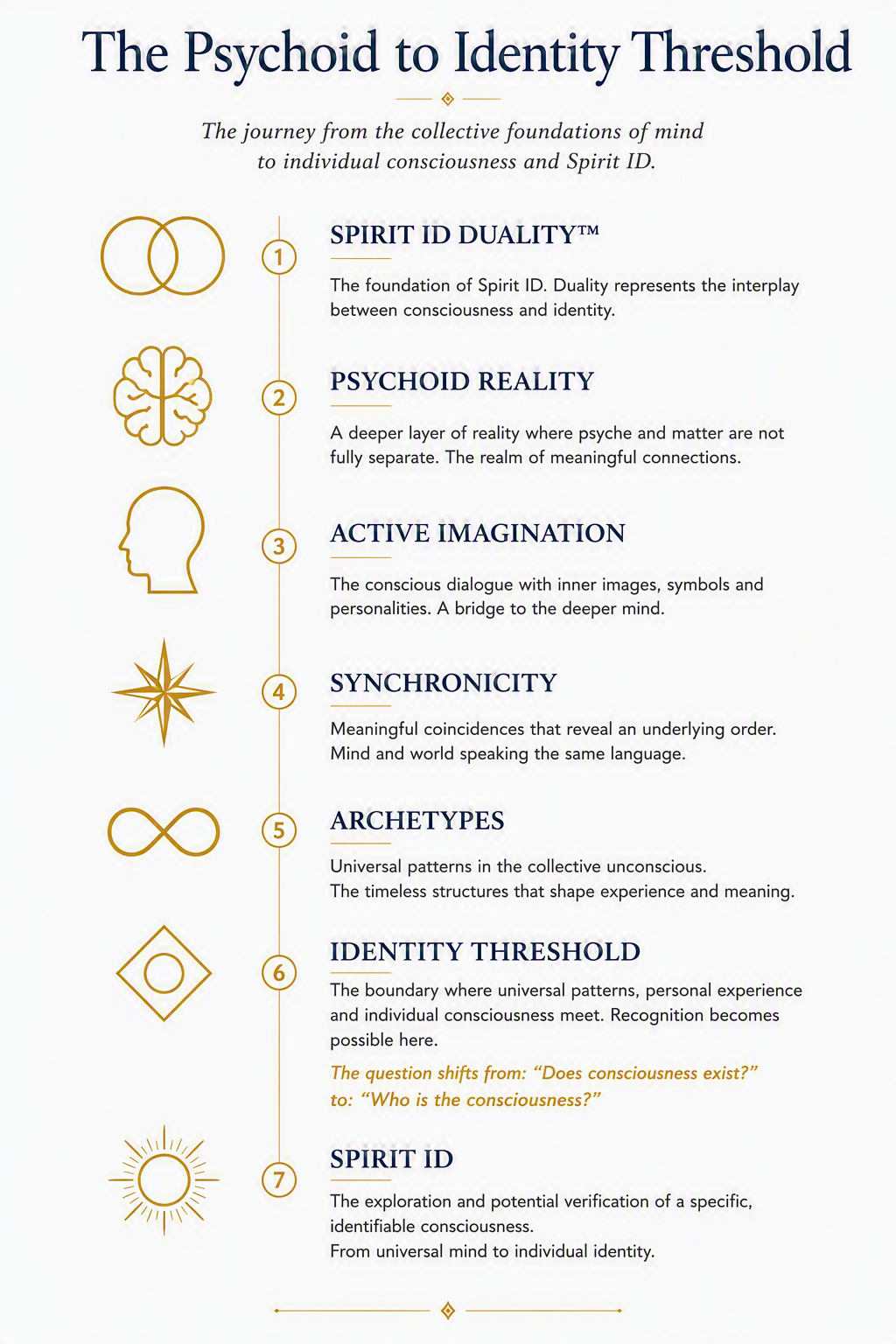
Each concept contributes to a deeper understanding of consciousness. Together, they form a pathway from the universal structures of mind toward the possibility of recognizing individual identity.
Jung’s psychoid concept points toward a possible connection between psyche and matter. The nature of that connection remains unknown. Spirit ID begins at the point where meaningful information becomes observable and asks whether such information can lead to the recognition of a specific identity.