The Spirit ID Framework presents a structured approach to understanding how awareness, identity, and consciousness interact across life, transition, and continuity beyond the physical body.
It is based on a progression from observed phenomena to a coherent model that explains how awareness integrates, fragments, and maintains identity.
—
Core Principles
All experience unfolds within awareness. The framework is built on two fundamental conditions:
- Integration → coherence, unity, stability
- Fragmentation → division, instability, separation
These conditions determine:
- how life is experienced
- how transition is perceived
- how identity continues beyond the body
—
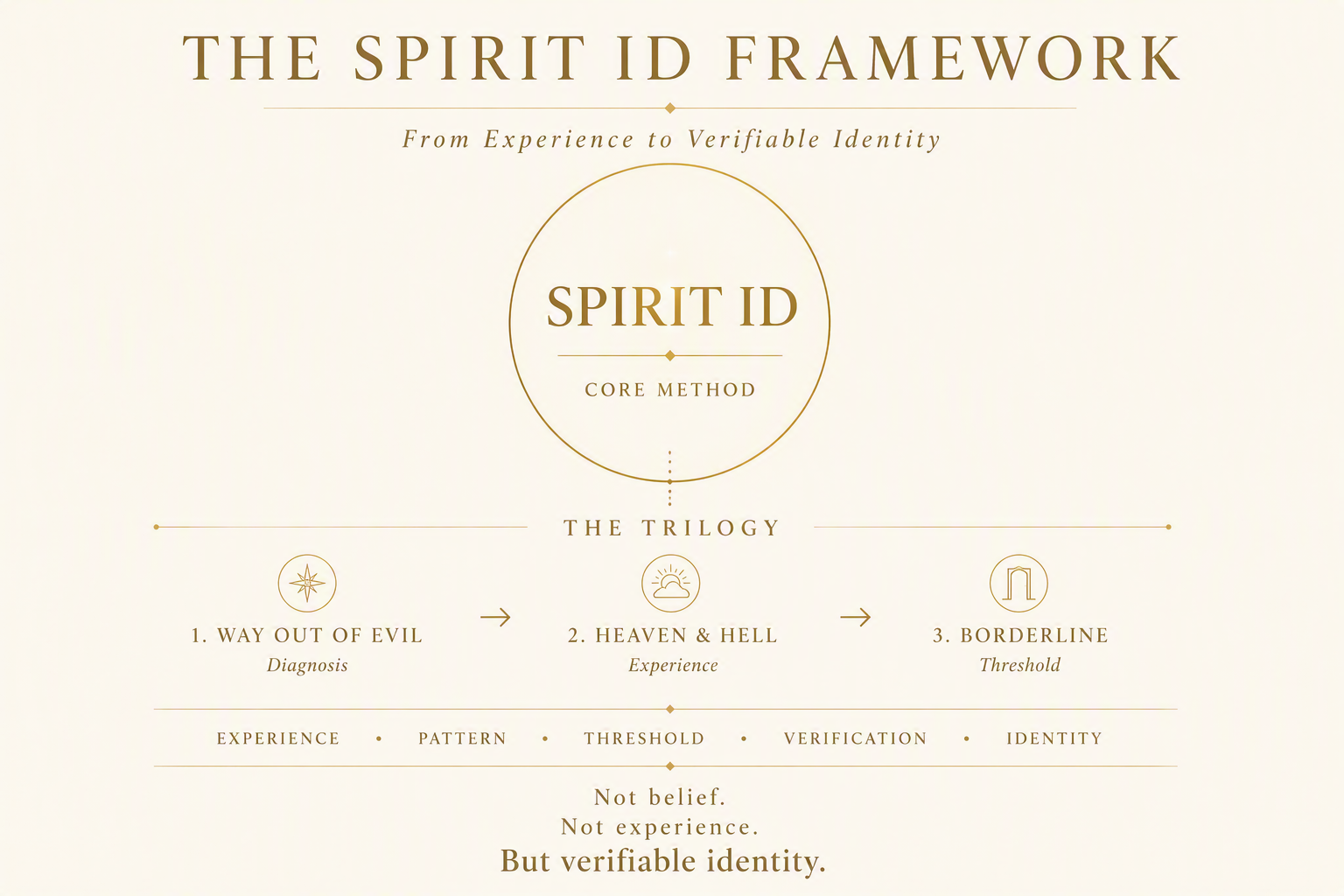
The Trilogy (The Developmental Path)
The Spirit ID Framework develops through a progression of three works, each addressing a distinct phase in the understanding of consciousness:
A WAY OUT OF EVIL
Focuses on fragmentation — how divided awareness leads to instability and destructive patterns, and how integration restores coherence.
HEAVEN AND HELL
Explores experiential states of consciousness, showing how integration and fragmentation are perceived subjectively.
ACROSS THE BORDERLINE
Examines the threshold between life and death through early observations of consciousness beyond the body.
—
From Trilogy to Framework
The trilogy establishes the foundation through lived experience and structured observation. From this foundation, the framework emerges as a method of verification.
—
Elements of the Framework
Introduces a structured model for verifying identity through coherence and stability of awareness.
Presents the complete framework, integrating all elements into a unified system for understanding consciousness and identity.
—
Final Synthesis
Awareness → fragmentation → instability → loss of coherence → non-recognition
—
Conclusion
The Spirit ID Framework is not a belief system, but a structured model describing how awareness forms identity, how it transitions beyond the physical body, and how continuity can be recognized.
The framework does not define what to believe —
it describes the conditions under which awareness becomes coherent and recognizable.