
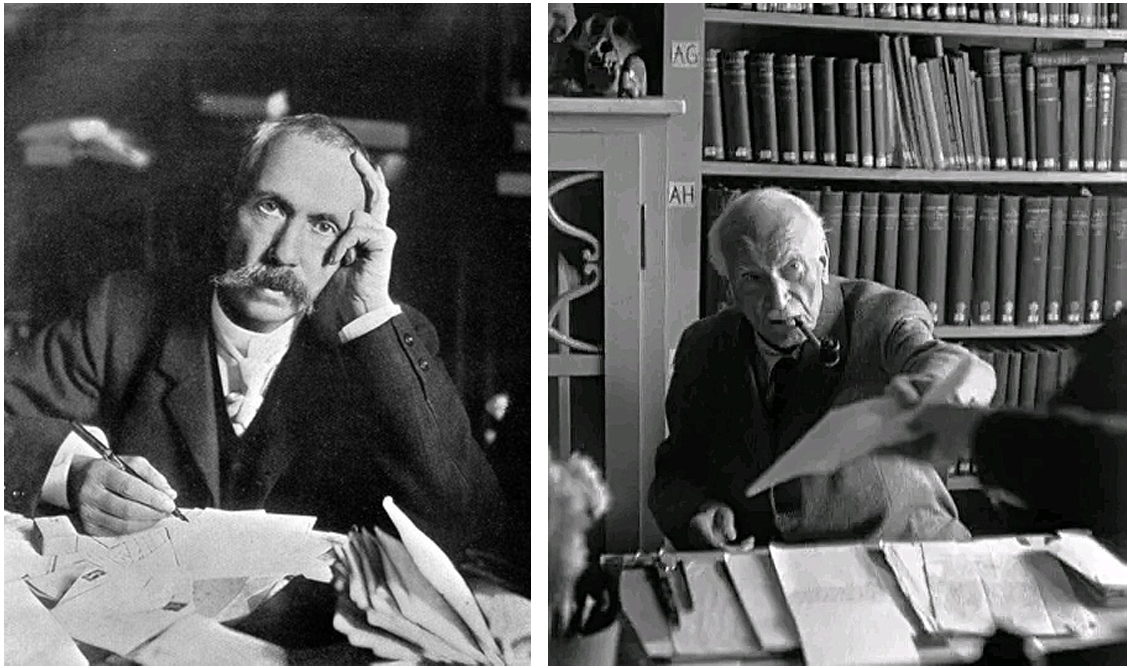
Photo: Charles Richet and Carl G. Jung
A Shared Frontier at the Limits of Knowledge
Charles Richet and Carl Gustav Jung belonged to the same historical moment in which the limits of psychology, biology, and human consciousness were being actively questioned. Although they approached these questions from different directions, their work converged on a shared frontier.
They were not collaborators in the practical sense, nor did they pursue identical research programs. Yet they were aware of each other’s work, moved within overlapping intellectual circles, and addressed closely related problems from complementary perspectives.
Overlapping Scientific Worlds
Richet operated primarily within physiology and experimental science, extending his curiosity into what he termed metapsychics—phenomena that appeared to exceed known psychological and biological explanations.
Jung, trained as a psychiatrist, encountered similar boundary phenomena through clinical observation, dream analysis, and the study of unconscious processes. He was deeply interested in psychical research and followed developments in European investigations into telepathy, mediumship, and anomalous cognition.
Both men engaged with institutions and thinkers associated with psychical research in Europe, including societies and publications where questions of telepathy, survival, and nonlocal aspects of mind were debated seriously.
Mutual Awareness and Intellectual Respect
Jung was familiar with Richet’s work and with the broader metapsychical research tradition in which Richet played a central role. He referenced related empirical findings when discussing phenomena that challenged purely materialist explanations of the psyche.
Richet, for his part, followed developments in psychology and psychiatry, recognizing that any adequate account of anomalous phenomena would eventually require deeper understanding of the human psyche.
While Richet resisted premature psychological or spiritual interpretations, Jung supplied precisely what Richet lacked: a conceptual framework for understanding the inner consequences of such phenomena.
Different Strengths, Complementary Limits
Richet’s strength lay in observation, documentation, and scientific restraint. He insisted that unexplained facts must not be dismissed, even when their explanation was unavailable.
Jung’s strength lay in synthesis. He articulated how encounters with non-ordinary phenomena affected responsibility, identity, and the psyche as a whole, warning of the dangers posed by unconscious forces left unexamined.
Yet both reached limits they could not cross. Richet lacked a method to validate identity and continuity. Jung lacked an empirical framework to verify survival beyond symbolic or psychological interpretation.
A Shared Unresolved Question
The question neither could resolve concerns continuity of individual consciousness. Richet asked whether anomalous information could be validated. Jung asked what such continuity would mean psychologically.
Together, their work defined a problem space larger than either discipline alone could contain. They outlined a frontier where science and psychology meet, but where method remained underdeveloped.
The Intersection They Made Visible
Where Richet documented phenomena and Jung articulated psychological consequences, the methodological gap remained.
It is within this shared but unresolved space that a new approach becomes possible— one that neither reduces phenomena to belief, nor dissolves them into metaphor.
Richet and Jung did not complete this work. But by approaching the same frontier from different directions, they made its contours unmistakably clear. At this intersection, Metapsychics Science™ now formally emerges, with Spirit ID as its validation framework for individual consciousness beyond biological death.
References
-
Richet, C. (1923). Thirty Years of Psychical Research.
London: Macmillan. -
Jung, C. G. (1952). Synchronicity: An Acausal Connecting Principle.
In Collected Works, Vol. 8. Princeton University Press. -
Shamdasani, S. (2003). Jung and the Making of Modern Psychology.
Cambridge University Press. -
Alvarado, C. S. (2002).
Charles Richet and the Scientific Study of Psychical Phenomena.
Journal of the Society for Psychical Research, 66, 1–26.